By ANNIKA HAMMERSCHLAG, Associated Press
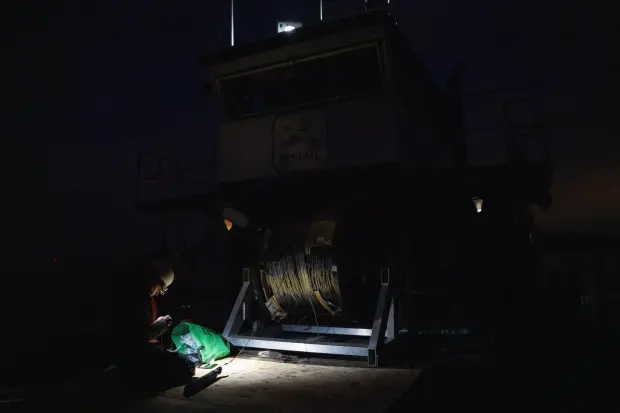
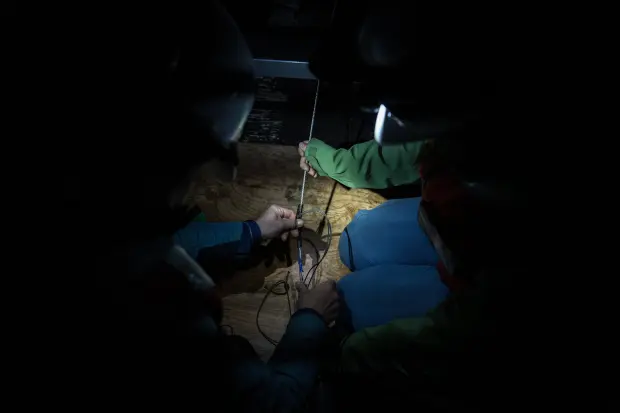
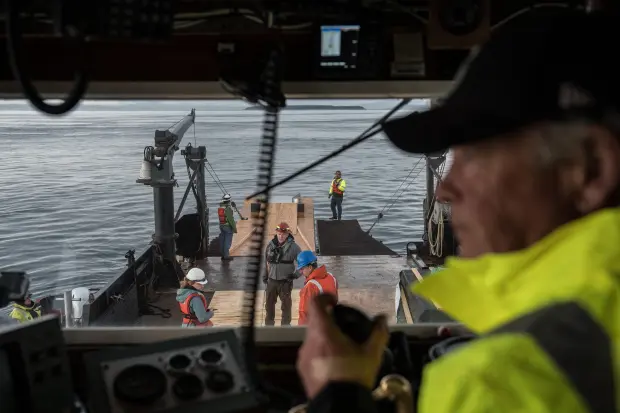
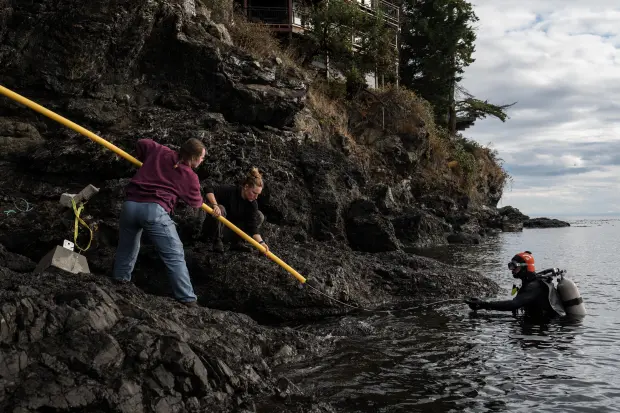
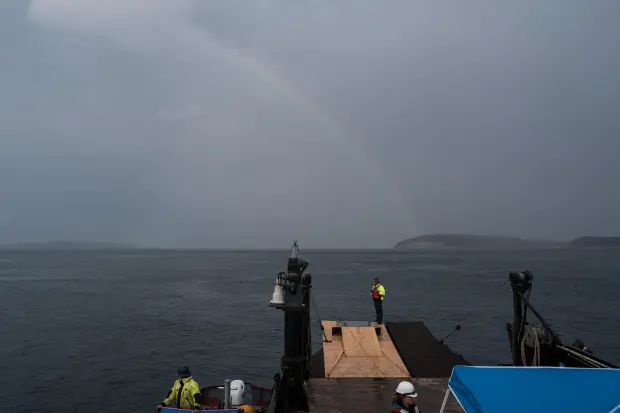
SAN JUAN ISLAND, Wash. (AP) — As dawn broke over San Juan Island, a team of scientists stood on the deck of a barge and unspooled over a mile of fiber-optic cable into the frigid waters of the Salish Sea. Working by headlamp, they fed the line from the rocky shore down to the seafloor — home to the region’s orcas.
The bet is that the same hair-thin strands that carry internet signals can be transformed into a continuous underwater microphone to capture the clicks, calls and whistles of passing whales — information that could reveal how they respond to ship traffic, food scarcity and climate change. If the experiment works, the thousands of miles of fiber-optic cables that already crisscross the ocean floor could be turned into a vast listening network that could inform conservation efforts worldwide.
The technology, called Distributed Acoustic Sensing, or DAS, was developed to monitor pipelines and detect infrastructure problems. Now University of Washington scientists are adapting it to listen to the ocean. Unlike traditional hydrophones that listen from a single spot, DAS turns the entire cable into a sensor, allowing it to pinpoint the exact location of an animal and determine the direction it’s heading.
“We can imagine that we have thousands of hydrophones along the cable recording data continuously,” said Shima Abadi, professor at the University of Washington Bothell School of STEM and the University of Washington School of Oceanography. “We can know where the animals are and learn about their migration patterns much better than hydrophones.”
-
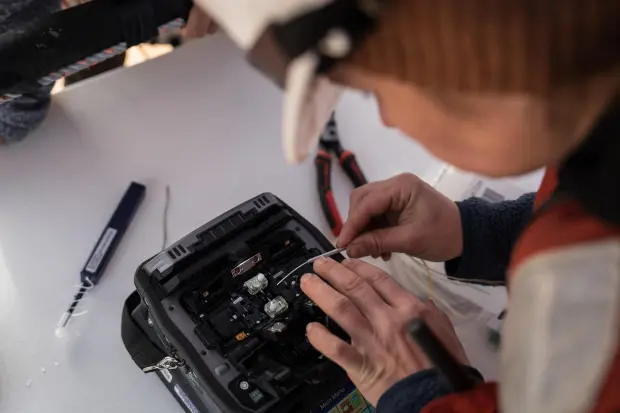
Isabelle Brandicourt, a graduate student at the University of Washington School of Oceanography, prepares to deploy a 1.3-mile fiber-optic cable to test whether internet cables can detect endangered orca vocalizations near San Juan Island, Wash., Friday, Oct. 10, 2025. (AP Photo/Annika Hammerschlag)

1 of 11
Isabelle Brandicourt, a graduate student at the University of Washington School of Oceanography, prepares to deploy a 1.3-mile fiber-optic cable to test whether internet cables can detect endangered orca vocalizations near San Juan Island, Wash., Friday, Oct. 10, 2025. (AP Photo/Annika Hammerschlag)
Expand
The researchers have already proven the technology works with large baleen whales. In a test off the Oregon coast, they recorded the low-frequency rumblings of fin whales and blue whales using existing telecommunications cables.
But orcas present a bigger challenge: Their clicks and calls operate at high frequencies at which the technology hasn’t yet been tested.
Fighting for survival
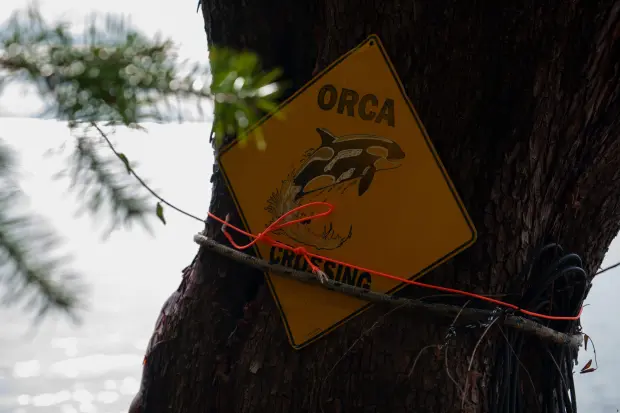
The stakes are high. The Southern Resident orcas that frequent the Salish Sea are endangered, with a population hovering around 75. The whales face a triple threat: underwater noise pollution, toxic contaminants and food scarcity.
“We have an endangered killer whale trying to eat an endangered salmon species,” said Scott Veirs, president of Beam Reach Marine Science and Sustainability, an organization that develops open-source acoustic systems for whale conservation.
The Chinook salmon that orcas depend on have declined dramatically. Since the Pacific Salmon Commission began tracking numbers in 1984, populations have dropped 60% due to habitat loss, overfishing, dams and climate change.
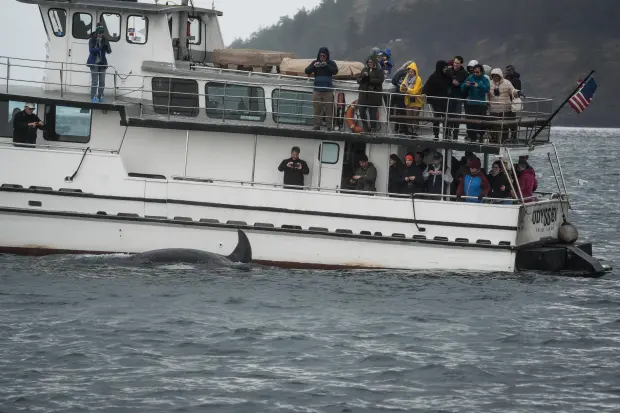
Orcas use echolocation – rapid clicks that bounce off objects – to find salmon in murky water. Ship noise can mask those clicks, making it difficult for them to hunt.
If DAS works as hoped, it could give conservationists real-time information to protect the whales. For instance, if the system detects orcas heading south toward Seattle and calculates their travel speed, scientists could alert Washington State Ferries to postpone noisy activities or to slow down until the whales pass.
“It will for sure help with dynamic management and long-term policy that will have real benefits for the whales,” Veirs said.
The technology would also answer basic questions about orca behavior that have eluded scientists, such as determining whether their communication changes when they’re in different behavioral states and how they hunt together. It could even enable researchers to identify which sound is coming from a particular whale — a kind of voice recognition for orcas.
Beyond the Salish Sea
The implications extend far beyond the Salish Sea. With some 870,000 miles (1.4 million kilometers) of fiber-optic cables already installed underwater globally, the infrastructure for ocean monitoring largely exists. It just needs to be tapped.
“One of the most important challenges for managing wildlife, conserving biodiversity and combating climate change is that there’s just a lack of data overall,” said Yuta Masuda, director of science at Allen Family Philanthropies, which helped fund the project.
The timing is critical. The High Seas Treaty enters into force in January, which will allow for new marine protected areas in international waters. But scientists still don’t understand how human activities affect most ocean species or where protections are most needed. A dataset as vast as the one the global web of submarine cables could provide might help determine which areas should be prioritized for protection.
“We think this has a lot of promise to fill in those key data gaps,” Masuda said.
Back on the barge, the team faced a delicate task: fusing two fibers together above the rolling swell. They struggled to align the strands in a fusion splicer, a device that precisely positions the fiber ends before melting them together with an electric current. The boat rocked. They steadied their hands and tried again, and again. Finally, the weld held.
Data soon began flowing to a computer on shore, appearing as waterfall plots — cascading visualizations that show sound frequencies over time. Nearby, cameras trained on the water stood ready so that if a vocalization was detected, researchers could link a behavior with a specific call.
All that was left was to sit and wait for orcas.
Follow Annika Hammerschlag on Instagram @ahammergram.
The Associated Press receives support from the Walton Family Foundation for coverage of water and environmental policy. The AP is solely responsible for all content. For all of AP’s environmental coverage, visit https://apnews.com/hub/climate-and-environment
Originally Published: