The taverns of Quebradillas, Puerto Rico, were nothing like the dimly lit, hushed bars of the mainland United States. These were riotous, vibrant spaces, thick with the scent of frying fish and plantains. Entire families gathered around packed tables, small children darted between wooden stools, and old men sipped rum while playing the cuatro and güiro, singing songs passed down through generations.
In Puerto Rico, these taverns were more than watering holes. They were neighborhood gathering spots where food, music, and conversation flowed together, and where cultural traditions were passed from one generation to the next.
For María Eugenia Nieves Escoriaza, better known as Geña, these are among her first memories, reaching back to when she was four years old. To her, the tavern was an extension of home.
“These taverns were the gathering places of my childhood. Puerto Ricans really love their music, and it’s everywhere, from the streets to these taverns,” she says.
It was in the glow of those nights that Geña first learned what it meant to be part of something larger than herself. Her father, a self-described bohemio, wasn’t a professional musician, but he had an instinct for song.
When he heard her sing, he made sure she had a stage, even if it was just the worn floor of a crowded tavern. “I was his little singer. If he knew I could sing, then he knew I should be there,” Geña recalls.
She absorbed the aguinaldos sung at Christmas, décimas with their improvised verse, and the corta-venas — boleros so steeped in heartbreak they were jokingly called “wrist-cutters.” The men in the taverns played Los Panchos and Daniel Santos, their trío romántico ballads the same ones her father crooned at home.
The music followed her to New York City, where she arrived at 19, carrying both her island’s repertoire and the aftermath of a near-death experience. In New York, she studied theater at the Lee Strasberg Institute on a full scholarship, sang with underground bands, and even recorded vocals for the soundtrack of the film The Believer. But the city’s relentless pace left her restless, always searching for a steadier rhythm.
When she came to Pittsburgh in 2004, the move was meant to be temporary. If New York had swallowed her whole, Pittsburgh gave her space to breathe. She enrolled at the University of Pittsburgh to study music, graduating in 2009 with a major in music and a minor in French. A year after arriving, her daughter was born. “She was an anchor, a grounding force,” Geña says.
Still, something was missing. The boleros and folk rhythms of her youth weren’t being played here. That changed when she met Carlos Peña.
Two Lives, One Sound
If you ask Carlos Peña, he’ll say his story isn’t as dramatic. But for a kid growing up in Pittsburgh, the son of a Colombian immigrant, it was its own kind of journey.
Unlike Geña, Carlos spent most of his childhood resisting the very music he would later dedicate his life to. But music was in the house, whether he acknowledged it or not. His father’s records: Los Panchos, Daniel Santos, all the icons of the Great Latin American Songbook played in the background, the same music that had once filled the taverns of Geña’s childhood, seeping into his subconscious even as he ignored them in favor of jazz and rock.
“I wasn’t surrounded by other people like me. Most of the other kids were just American kids with American parents. You just want to fit in,” says Carlos.
At 12, he picked up a guitar his sister had left behind and taught himself to play. He explored every style — rock, blues, jazz — without ever settling on one. By the mid-2000s, he was working as a music librarian at the University of Pittsburgh, surrounded by archives of scores and recordings. That’s where Geña would often find him, sparking long conversations about old songs.
They don’t remember exactly how they first met in 2007, but they remember the first time they played together.
“For me, it was like unlocking a part of myself I had ignored for years,” Carlos says. “I realized that this music had been with me all along. I just didn’t know it.”
For Geña, the recognition was immediate. “I’ve tried playing with many guitar players. Carlos was the first one who wasn’t messing around. He had the sensibility. He could go deep into the music, into all its subtleties. Nobody else could do that.”
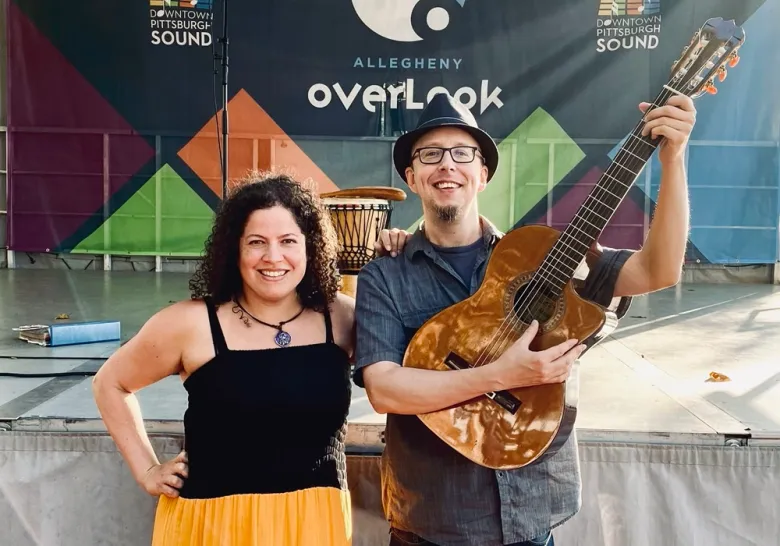
Without ever formally deciding, they became Geña y Peña: a duo blending Puerto Rican bolero traditions with Colombian echoes, rooted in two different paths that converged in Pittsburgh. Geña handles vocals and percussion, while Carlos plays guitar.
A Songbook of Belonging
In Pittsburgh, Geña y Peña brought that repertoire to La Palapa in the South Side, at Con Alma, and at the Carnegie Museum of Art, where their boleros echoed in a space more often reserved for classical or contemporary music.
Their music had the power to transform a crowd during Pittsburgh’s Light Up Night, one of the city’s biggest events of the year. The December cold was unrelenting, their heater broken, and hecklers were shouting “No comprende!” and demanding “White Christmas.” Geña pulled up the lyrics and started singing, but before the first verse was over, they had already turned and walked away.
As they played on, Latino families gathered, singing along with boleros they hadn’t heard in decades. The hecklers’ jeers faded.
“All the circumstances were conspiring to make it a difficult gig,” Carlos says. “But as soon as we started playing, it was like we were floating on magic, and the people could feel it. It’s like Latinos started coming out of the woodwork and gathering”
The music had reclaimed the night. “That ended up being the best night ever,” Geña says. “When Latinos stopped and sang with us, and told us they remembered these songs from their growing-up days, the music reminded them of home.”
Harmony and Legacy
For Geña and Carlos, this isn’t just about music. It’s about identity. About history. About the stories embedded in every song they perform.
In the U.S., we talk about the “Great American Songbook,” that canon of Tin Pan Alley tunes and jazz standards that define an era. But Carlos points out that Latin America has its own equivalent.
“There’s a Great Latin American Songbook, too. It’s just as vast, just as important. And it still speaks to people across generations. It also serves as a source of comfort, bonding, and solidarity for Latin Americans, in that it enables them to feel connected to their cultures and traditions while living here in the U.S. at this particular point in space and time. I think it helps remind them that their roots and culture are things that should still be embraced and celebrated, here and now,” he says.
Now, 17 years after they first played together, they still communicate best through music. When they’re not performing, they’re teasing each other. “Carlos is probably the bigger perfectionist. But he’s also the bigger joker,” Geña says.
While their music drips with drama, the duo remains grounded and practical. “We reserve our drama for our songs,” Geña says.
They dream of travel, of playing in Puerto Rico and Colombia, bringing their music back to the places that shaped it. They dream of a space that feels like the taverns of Geña’s childhood: a bohemian wooden bar, intimate and warm, with a small audience filled with families.
For now, though, they are content with the simplest ambition of playing the songs people forgot they knew.
“I hope Latino listeners feel transported to a different era through our music,” Geña says. “That they connect with their identity and heritage. And for those who aren’t Latino, I hope the music translates spiritually, beyond words.”
This article appears in Fall Guide 2025.